Introducing FITA
FITA (Far-edge IoT device mAnagement) is a framework that integrates Far-edge IoT device in Kubernetes, allowing them to be part of the Kubernetes orchestration and lifecycle monitoring procedures. Far-edge IoT devices in the context of FITA are the devices equipped with sensors and actuators that sense and act in the environment in which they are installed. Additionally, these devices are composed of microcontrollers, which do not have enough resources to run the Kubernetes Kubelet.
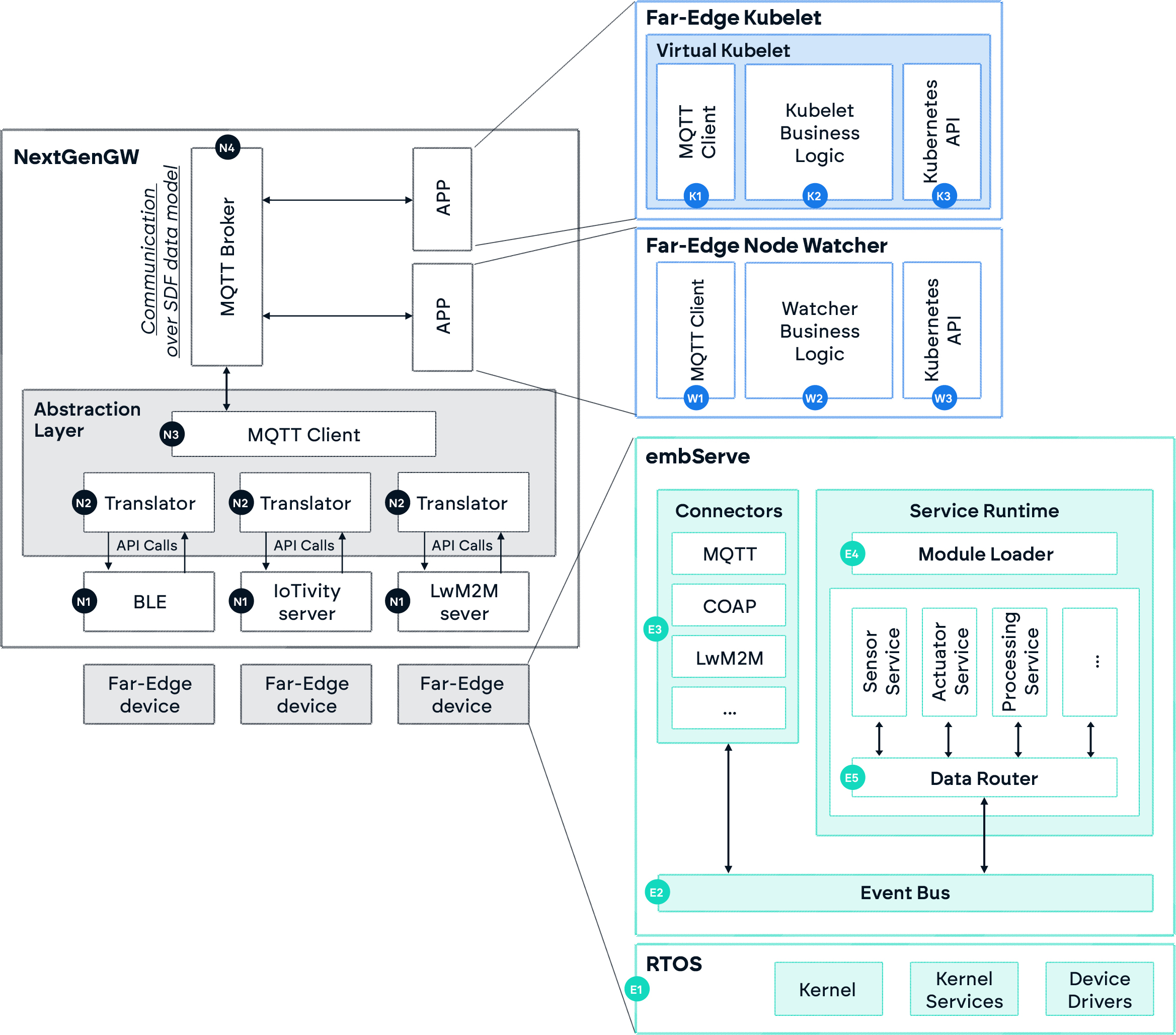
The Figure below details FITA's architecture, highlighting the main components that allow integrating Far-edge IoT devices in the Kubernetes cluster.
-
embServe is the runtime of Far-edge IoT devices. It implements a service-oriented architecture, allowing the deployment and update of services (or workloads) independently of the base firmware using standard protocols and data models. Thus, when installed in Far-edge IoT devices, embServe removes the need for full-flash updates by enabling the dynamic modification of the device behaviour through the deployment and update of different workloads that can run simultaneously on the device.
-
NextGenGW is the gateway that addresses the heterogeneity of Far-edge IoT devices regarding communication protocols and data models. It exposes Far-edge devices following the IETF SDF semantic definition format, bound with MQTT. It homogenises communication with heterogeneous Far-edge devices using a single communication protocol and data model.
-
Far-edge Node Watcher is responsible for monitoring the installation and removal of Far-edge devices. When a new Far-edge device is connected, NextGenGW publishes the details of this device in the "announce" topic. When a Far-edge device is disconnected, NextGenGW publishes such an event in the "unregister" topic. The Far-edge Node Watcher subscribes to these topics and creates or deletes the digital representations of Far-edge devices in the Kubernetes cluster by creating or deleting the Far-edge Kubelet associated with them.
-
Far-edge Kubelet bridges Kubernetes with the Far-edge devices. It instantiates a virtual node in the Kubernetes cluster that is associated with the Far-edge device it is responsible for, and connects to the Kubernetes control plane through the Kubernetes API as a standard Kubelet. Following this strategy allows the Kuberentes control plane to look at the virtual nodes associated with Far-edge devices as regular nodes in the cluster and consider them for scheduling. The workload deployment commands are received by the Far-edge Kubelet, which downloads the Far-edge Kubelet workload from an OCI-compliant registry and deploys it in the Far-edge device by interacting with the NextGenGW.
In Getting Started, we use an hands-on example to further explains how are Far-edge devices added and represented in the Kubernetes cluster, as well as how to deploy workloads on Far-edge devices.